
Custom Woven Banarasi Sarees

Process, Loom Development, MOQ, Timeline & Cost

If you want to create an exclusive Banarasi saree collection instead of selecting from existing designs, Weave 365 offers custom woven Banarasi saree development for private label brands, fashion labels, designers, boutiques, wholesalers, and export businesses.

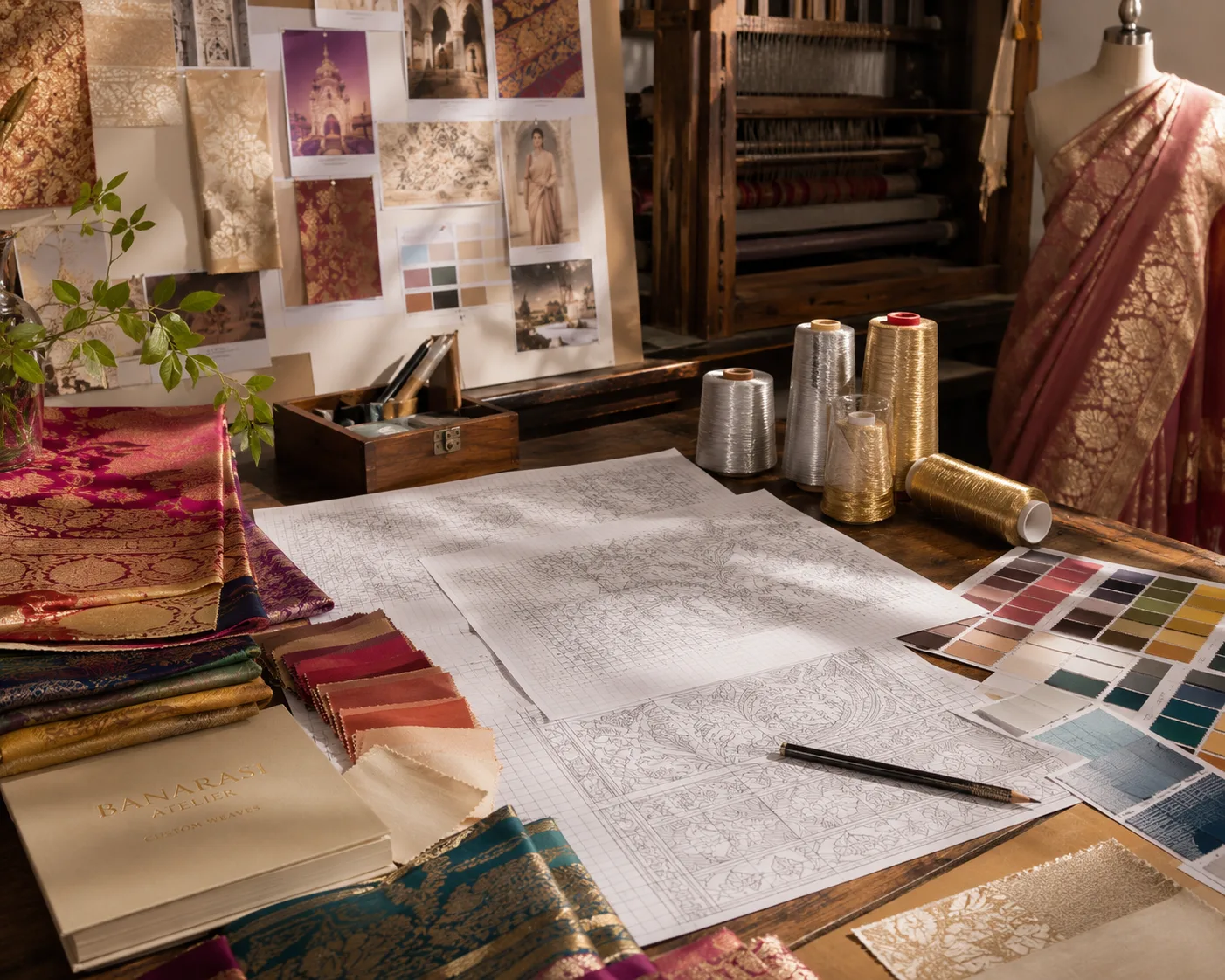
Unlike ready-made wholesale collections, custom weaving begins with your design concept. Each project involves technical feasibility assessment, loom development, weave planning, yarn and zari selection, sampling, and production before full-scale weaving starts. This process enables you to develop a unique Banarasi saree that reflects your brand identity rather than choosing from existing catalogue designs.
Varanasi Master Silk Weaver at Handloom
Varanasi Master Weavers Network

What is a Custom Woven Banarasi Saree?

A custom woven Banarasi saree is a saree created through a dedicated weaving process based on your brand's design requirements. Unlike ready-to-ship products, the weaving is planned specifically for your project, with decisions made on the weave structure, motifs, fabric, zari, colours, and finishing before production begins.

Each project starts with design evaluation and technical planning, followed by loom development, sampling (where required), and production. This approach enables businesses to develop exclusive Banarasi sarees that are not part of standard wholesale collections.

Production Matrix, Weaving Workflow & Timeline

Select your preferred production method to compare Minimum Order Quantities (MOQ), pre-weaving lead times, production timelines, and weaving capabilities for Handloom and Powerloom Banarasi sarees.

Weaving Workflow & MOQHandloomPowerloom
Minimum Order Quantity (MOQ)
4 Pieces / Design50 Pieces / Design
Pre-Weaving Preparation & Loom Development
  • Design graphing (Naksha)
  • Yarn selection
  • Dyeing
  • Warp (Tana) preparation
  • Weft (Bana) preparation
  • Jacquard card punching (if applicable)
  • Loom setup
30–45 Working Days30–45 Working Days
Weaving, Finishing & Dispatch Timeline
  • Handloom weaving
  • Quality inspection
  • Finishing & polishing
  • Packing
  • Dispatch
20–90 Working Days30–60 Working Days
Note: The final MOQ is confirmed after our weaving team reviews your design and technical requirements.

Acceptable Design Inputs for Custom Weaving

To help us evaluate your custom weaving requirements, you may share one or more design references with our team.

Design Reference Image

Photos, catalog snapshots, or vintage heirloom samples

Hand Sketch

Freehand drawings of border, pallu, or body motifs

Digital Artwork

PSD, AI, EPS, or vector graphic files

CAD File

Jacquard CAD files, punch patterns, or graph files

Motif Reference

Isolated floral, Paisley, floral jaal, or geometric motifs

Fabric Swatch

Physical swatch or high-resolution macro fabric photo

Colour Inspiration

Pantone shades, moodboards, or custom colorways

Brand Concept

Theme guidelines, storyboards, or bridal storybook

How Our Varanasi Weaving Team Assists You.

From technical feasibility to final production planning, our master weavers bridge the gap between your conceptual vision and the physical loom.

100%Design Intent
Preserved
7Areas of
Expertise
1
1

Technical Feasibility Review

Reviewing the technical feasibility of your design for traditional Banarasi weaving.

2
2

Weave & Yarn Structuring

Determining the appropriate weave structure, weaving technique, fabric composition, and zari combination required for your design.

3
3

Motif & Color Curation

Suggesting suitable motifs, colour combinations, and finishing options to achieve the desired look.

4
4

Practical Weaving Optimization

Identifying any design elements that may require modification for practical weaving and production.

5
5

Design Intent Preservation

Recommending the most suitable weaving approach while preserving your original design intent.

6
6

Commercial & Timeline Guidance

Providing guidance on the estimated MOQ, sampling requirements, pre-production charges, and expected production timeline.

7
7

Full Lifecycle Support

Guiding you through every stage, from loom development and sample approval to final production.

Custom Banarasi Saree Weaving Process

A transparent, step-by-step journey from initial artwork review to final loom execution and quality inspection.

STAGE 01 OF 07

Share Your Design

Send us your design reference, artwork, sketch, concept, or inspiration.

Photos, sketches, CAD files, or physical fabric swatches accepted
Target colorway and quantity requirement assessment
Complete brand privacy and design confidentiality
Step 1 of 7

Loom Development

Loom development is the process of developing and configuring a weaving loom according to the approved design and technical weaving specifications before production begins.

During loom development, our weaving team:

01

Analyses the approved design and its weaving requirements.

02

Determines the appropriate weave structure and weaving technique.

03

Selects the suitable yarn, fabric composition, and zari combination.

04

Plans motifs, borders, pallu, and colour placement.

05

Prepares the loom settings and weaving specifications required for production.

06

Conducts trial adjustments where necessary to ensure accurate weaving.

Loom development is a critical stage because it directly influences the appearance, fabric quality, weaving accuracy, durability, and production efficiency of the finished Banarasi saree.

Commercial Parameters & Guidelines

Clear, transparent operational benchmarks for planning your custom woven saree orders.

Minimum Order Quantity (MOQ)

Custom loom development involves design planning, technical development, and loom preparation before production begins. As a result, a minimum order quantity (MOQ) is required to make the weaving process commercially viable.

The typical minimum order quantity (MOQ) is:

From 4 pcsHandloom / Design
From 50 pcsPowerloom / Design

The final MOQ may vary depending on:

  • Design complexity
  • Weave structure
  • Fabric composition
  • Zari type
  • Number of colours
  • Production feasibility

Note: The final MOQ is confirmed after our weaving team reviews your design and technical requirements.

Timeline

The development and production timeline for a custom woven Banarasi saree depends on the design complexity, weave structure, yarn and zari availability, sampling requirements, and order quantity.

1. Pre-Weaving Development30–45 Working Days

Before weaving begins, a typical project progresses through the following stages:

  • Design review & technical feasibility assessment
  • Weave structure & material planning
  • Loom development & setup
  • Sample development (if required)
  • Sample review & approval
2. Weaving & Production20–90 Working Days

Once the design and sample are approved, production typically includes:

  • Bulk weaving using traditional Banarasi weaving techniques
  • Finishing & quality inspection
  • Packing & dispatch

Note: The estimated production timeline is shared after our weaving team reviews your design, technical requirements, and order quantity.

Pre-Production Charges

Every custom woven Banarasi saree project requires design development, technical planning, and loom preparation before production begins.

Pre-production charges may include:

  • Design evaluation
  • Technical consultation
  • Weave structure planning
  • Loom development and setup
  • Design development
  • Sample development (if required)
  • Production planning

The final pre-production cost depends on:

  • Design complexity
  • Fabric composition
  • Zari type and quality
  • Weaving technique
  • Sampling requirements
  • Project scope

Note: Pre-production charges are quoted after our weaving team reviews your design and technical requirements.

Estimated Saree Cost

The cost of a custom woven Banarasi saree varies depending on the design specifications and production requirements. Since every custom weaving project is developed according to the approved design specifications, there is no standard price.

The final saree cost is determined by factors such as:

  • Design complexity
  • Fabric composition
  • Weave structure
  • Zari type and quality
  • Colour combinations
  • Weaving time and labour
  • Order quantity
  • Finishing requirements

If your project proceeds to bulk production, we will provide a detailed commercial quotation based on the approved design, final specifications, minimum order quantity (MOQ), and production requirements.

Note: A detailed cost estimate is shared after the design review and technical feasibility assessment are completed.

Complete Guide to Banarasi Saree Weave Techniques

Banarasi sarees are crafted using a variety of traditional weaving techniques, each offering a unique combination of craftsmanship, texture, motif formation, and production complexity. These weaving techniques can be applied to different Banarasi fabric bases, including Katan Silk, Kora (Organza), Georgette, Tissue, Satin, Cotton Silk, and other silk-blend fabrics. Depending on the chosen fabric, the same weave technique can produce different textures, drape, weight, and appearance. The breakdown below summarizes the most important Banarasi weave techniques and the fabric types in which they are commonly woven, helping buyers, designers, resellers, and textile enthusiasts understand their key differences.

Traditional Banarasi Weaving Techniques

These are the primary weaving methods used by Banarasi artisans to create motifs and patterns. Each technique differs in weaving process, craftsmanship, production time, and fabric appearance.

  • Kadhwa Weaving – Individual motifs woven separately without floats on the reverse.
  • Phekwa Weaving – Continuous supplementary weft weaving with floats on the back.
  • Cutwork Weaving – Floating threads are cut after weaving for a cleaner reverse finish.
  • Tanchoi Weaving – Dense silk weave with intricate self-patterns and minimal zari floats.
  • Jamdani Weaving – Supplementary weft technique for detailed floral and geometric motifs.
  • Brocade Weaving – Rich decorative weaving using silk and zari threads.

Banarasi Design & Motif Weaving Styles

These weaving styles define the visual appearance and decorative motifs of Banarasi sarees rather than the weaving mechanism itself.

  • Jangla Weaving – Large interconnected floral vine patterns across the fabric.
  • Meenakari Weaving – Multicolour silk highlights woven within zari motifs.
  • Butidar Weaving – Small repeating buti motifs distributed across the fabric.

Banarasi Fabric Base Weaves

These refer to the base fabric on which Banarasi motifs and weave techniques are created. The fabric influences the saree's texture, weight, drape, and overall appearance.

  • Katan Weaving – Fine pure silk plain weave with a smooth finish.
  • Kora Weaving – Crisp, lightweight silk organza base.
  • Organza Banarasi Weaving – Sheer organza fabric decorated with Banarasi motifs.
  • Georgette Banarasi Weaving – Lightweight crepe-textured fabric with fluid drape.
  • Satin Weaving – Smooth and lustrous fabric with a glossy surface.
  • Dupion Weaving – Textured silk fabric woven from uneven silk yarns.
  • Tissue Weaving – Lightweight shimmering fabric woven with silk and metallic zari.

Banarasi Blended Fabric Weaves

These fabrics combine two or more natural fibres to achieve a balance of appearance, texture, durability, comfort, and cost.

  • Cotton-Silk Weaving – Blend of cotton and silk for comfort and sheen.
  • Silk Linen Weaving – Blend of silk and linen with a natural textured finish.
  • Silk Cotton Tissue Weaving – Tissue fabric woven using silk and cotton yarns.
  • Mashru Weaving – Traditional silk-cotton weave offering the appearance of silk with the comfort of cotton.

Traditional & Specialty Banarasi Weaves

Specialized or less commonly used weaving techniques that represent traditional craftsmanship and niche textile applications.

  • Ektara Weaving – A traditional weaving technique used for specific fabric constructions and niche Banarasi textiles.

Who is Custom Weaving Suitable For?

Custom woven Banarasi sarees are ideal for businesses and professionals looking to develop exclusive products instead of purchasing ready-made wholesale collections.

Custom weaving is suitable for:

Private Label Brands

Luxury Fashion Labels

Fashion Designers

Fashion Entrepreneurs

Boutique Owners

Bridal Wear Brands

Wedding Wear Collections

White Label Businesses

Export Buyers

Retail Chains

Corporate Gifting Projects

Premium Ethnic Wear Brands

Custom weaving is suitable for businesses that want to develop exclusive Banarasi saree collections under their own brand.

Custom Weaving vs Ready Collections

Choose Custom WeavingChoose Ready Collections
Exclusive brand designsReady-to-order collections
Private label manufacturingLow MOQ (5–10 pieces)
Custom weave structuresImmediate availability
Medium to large production quantitiesFaster dispatch
Long-term product developmentLower initial investment

Start Your Custom Banarasi Saree Development

If you already have a design, share your reference image, sketch, artwork, CAD file, or concept with our team. We will evaluate its weaving feasibility, recommend the most suitable Banarasi weave structure, fabric, yarn, and zari options, estimate the loom development cost, advise the Minimum Order Quantity (MOQ), and provide an estimated production and delivery timeline.

If your current requirement is only 5–10 pieces, we recommend selecting from our existing Banarasi Saree Wholesale Collections. Custom loom development is generally recommended for brands, designers, boutiques, wholesalers, exporters, and private-label businesses planning larger production quantities.

Ready to Bring Your Design to the Loom?

Whether you are developing a private label collection, designer collection, bridal collection, or an exclusive Banarasi saree range, our team can guide you through every stage of the process—from loom development and yarn preparation to weaving, quality inspection, finishing, packing, and dispatch.

Share your design with us to receive:

Weaving feasibility assessment
Recommended weave structure and fabric
MOQ recommendation
Loom development cost estimate
Production timeline
Quotation for custom manufacturing

Frequently Asked Questions

Got questions about custom weaving, loom setups, or sampling? Find answers below.